

Architecture
The Intent
Kodall’s architecture is designed to solve a fundamental challenge: completely isolating business logic from everything else. We’re enabling you to only do the work that produces value.
Simplified architecture diagram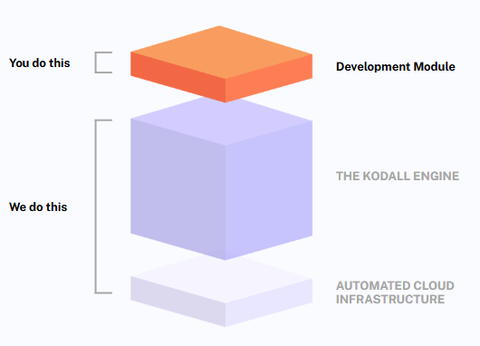
Your workspace is the Development Module, a sandboxed environment completely separated from the Kodall Engine. Your customizable logic sits safely on top, it can’t alter the underlying engine code, only pass parameters to it.
Kodall is secure by design because it’s structurally impossible for you to generate arbitrary code in the final software. For business specific automations, we’ve created a dedicated programming language, called Workflow. With Workflow, you create pure business code (rules for business objects), never platform code.
The Kodall Engine has no external dependencies and it is closed to developer modification.
This design guarantees that no matter how complex your custom business rules get, you can never introduce memory leaks, security holes, or platform instability.
By isolating business logic into a dedicated execution layer, the platform handles extreme data loads without degrading user experience. Kodall can process thousands of complex documents per second with automated data extraction while maintaining sub-second application responsiveness.
Detailed architecture diagram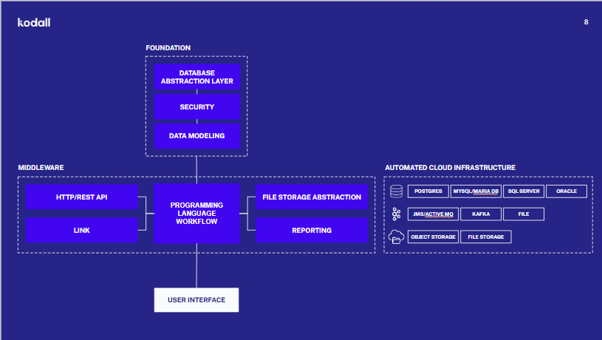
Foundation
Enforces data integrity, security policies, and database translation.
Middleware
Manages business rules and automations.
User Interface
Dynamically renders application views based on metadata.
Cloud Infrastructure
Provides managed persistence, queues, and object storage without exposing infrastructure complexity.
Foundation
The Foundation is the single point through which all data access must pass.
- Data Modeling: Defines business objects and relationships declaratively in the Development Module.
- Security: Positioned directly above Data Modeling. Because security sits at the Foundation level, access control (RBAC) and Row-Level Security (RLS) are enforced universally, regardless if data is accessed via UI, REST API, or background event.
- Database Abstraction: Translates business objects into native SQL, completely decoupling application logic from specific database technologies.
Middleware
The Middleware serves as the central execution and integration hub of Kodall.
- Workflow: Sitting at the center of the architecture, the Workflow programming language acts as the operational brain of the platform. All business logic, business object manipulations, and calculations run natively inside of the Workflow engine.
- API: Exposes endpoints automatically for external application integration. Every created business object automatically exposes its name, properties, and relationships directly in plain, human readable language.
- Link: Ingests asynchronous event streams directly into Workflow execution routines.
- File Storage Abstraction: Provides a unified interface for file operations across Object Storage (S3) and Block Storage.
- Reporting: Powered by the Fetch query engine, it runs queries against the entity graph without complex SQL joins, custom GraphQL resolvers, or OLTP performance degradation.
User Interface
The UI layer does not contain hardcoded forms or queries. It acts as an abstraction that dynamically renders views, structures, and tables directly from entity definitions and Workflow states.
When standard views aren't enough, Kodall seamlessly integrates custom UI components and external frontends through its SDKs and open APIs.
Cloud Infrastructure
We manage our own custom Cloud Orchestration Layer built on top of Kubernetes. Our platform automatically provisions, scales, and manages all underlying infrastructure components, without requiring manual DevOps intervention or infrastructure-as-code scripts.
Powering this orchestration layer is our owned bare-metal datacenter infrastructure, backed by automated cloud backups. By owning the physical compute and control plane, we deliver predictable high performance and resource isolation.
Because the entire infrastructure stack is automated and abstracted, applications built in the Development Module are hardware-agnostic. This is all aligned with our core principle: automating and keeping out of sight any tool or complexity that is unrelated to your business logic.
Client Access
Application access in Kodall is multi-device by design, delivering a unified user experience across web browsers and native mobile applications (iOS and Android).
- Dedicated Instance URL: Users log into their environment through a single access point configured during cloud provisioning (either a Kodall subdomain
application.kodall.comor a custom domainapplication.com). - Instant Deployment: Applications built with Kodall are deployed natively inside the platform's infrastructure, requiring zero external server configuration.
- Role-Based Access: The web environment adapts client access and platform tools dynamically based on user role. Users get standard application views. Admins get standard views plus system configuration options in the System Module. Developers get standard views, the System Module, and the Development Module, letting them model, test, deploy, and instantly see the standard application inside a single browser tab.
- Native Mobile Apps (iOS & Android): Kodall's mobile applications act as dynamic execution shells. Connecting to the instance URL ingests application metadata and automatically projects Search Views, Edit Views, and Workflows into native mobile interfaces.